
August 1944: Warsaw Rises
82 years ago, the biggest and longest uprising against Germany in occupied Europe during the Second World War began.

In the summer of 1944, the Soviet army continued its march westwards. Just over three years after Germany’s attack on the Soviet Union, millions of deaths, the killing of Eastern European Jewry, starvation, and forced labour, fascist Germany was losing. Before Germany’s invasion of the Soviet Union, the two had been allies. In August 1939, the two dictatorships had signed a so-called non-aggression pact in Moscow, which in fact had been an agreement on the joint dismemberment and occupation of the states of East-Central Europe. In accordance with this pact, Germany marched into Western Poland on September 1, 1939; the Red Army invaded Eastern Poland sixteen days later. Poland fell within a few weeks. A government in exile was established in London, which was allied with the Western powers. After Hitler betrayed his ally in June 1941, the Soviet Union entered the Western alliance. Within a few weeks, Poland and Moscow also signed an agreement in which the agreements reached in the German-Soviet pact of 1939 regarding Poland were officially declared invalid.
Yet, the Polish government had few illusions about the reliability of the Soviet Union as an ally. Despite Polish-Soviet cooperation in the face of German fascism, most notably in the form of the so-called Anders’ Army, a Polish formation in the Soviet Union which was active on Soviet territory until 1942, few Poles harboured any illusions about Moscow’s imperial ambitions. Thus, as the Red Army approached Warsaw, the Polish government in exile and commanders of the Polish Home Army (Armia Krajowa), the largest underground fighting force in occupied Europe, decided that the Polish capital had to be in Polish hands before the Soviets’ arrival. News had spread of how Polish resistance fighters had been disarmed by the Red Army in Eastern Poland, even persecuted and shot. This was the beginning of the Warsaw Uprising on August 1, 1944, the biggest and longest uprising against Germany in occupied Europe during the Second World War.
While the uprising began with soldiers of the Home Army attacking the German occupiers, large parts of Warsaw’s civilian population supported the fighters not only emotionally, but practically. For a short time, it seemed that Warsaw may prevail. One day after the beginning of the uprising, fourteen-year-old Wanda Przybylska noted in her diary:
“Such wonderful news! Oh, how beautiful this is! I am so delighted!!! Just now, a soldier came through the street bringing the news. The Bolsheviks are already in Warsaw, not far from here, in Ząbkowska Street. The bridges are already occupied by our men, so they could be in the city center at any moment. Everything is going excellently – Hooray!!! Hooray, Hooray!!! Brave boys! Apparently, all of Warsaw is controlled by our men.”
But her optimism did not last long. Only a few days later, she remembered how a year earlier the Jews in the Warsaw Ghetto had also fought against the Germans, but had then “perished to the last man. That is how it will be for us, too.” Her mood darkened further. On August 7, she noted:
“Our army is holding out magnificently, but the Bolsheviks are not coming, and the Germans are attacking and bombing us ever more fiercely, so that everything is burning and some districts are completely engulfed in flames. [...] We must not lose courage. We see how our boys are fighting bravely and not surrendering. It is a shame that we are beginning to lose hope.”
Warsaw was stuck in a terrible dilemma. Indeed, the Soviet army did not come to help the Polish resistance. The German occupiers reacted with brute force, slaughtering not only the men and women of the Home Army, but also tens of thousands of civilians. The largest massacre took place in Wola, a district in Western Warsaw, where up to 30,000 people were killed. Atrocities took place in Ochota, the neighbouring district. In the neighboring district of Ochota, the Germans, together with the SS brigade of the Russian collaborator Bronislaw Kaminski, also massacred approximately ten thousand people. On August 5, drunk soldiers broke into the Radium Institute, which had been founded in the early 1930s at the initiative of Marie Curie. Witnesses reported mass gang rapes of women and young girls that continued for days. Many of the victims were subsequently shot. The soldiers did not shrink from murdering the sick either; some of them were burned alive. After looting, the soldiers set the institute on fire, while people were still inside.
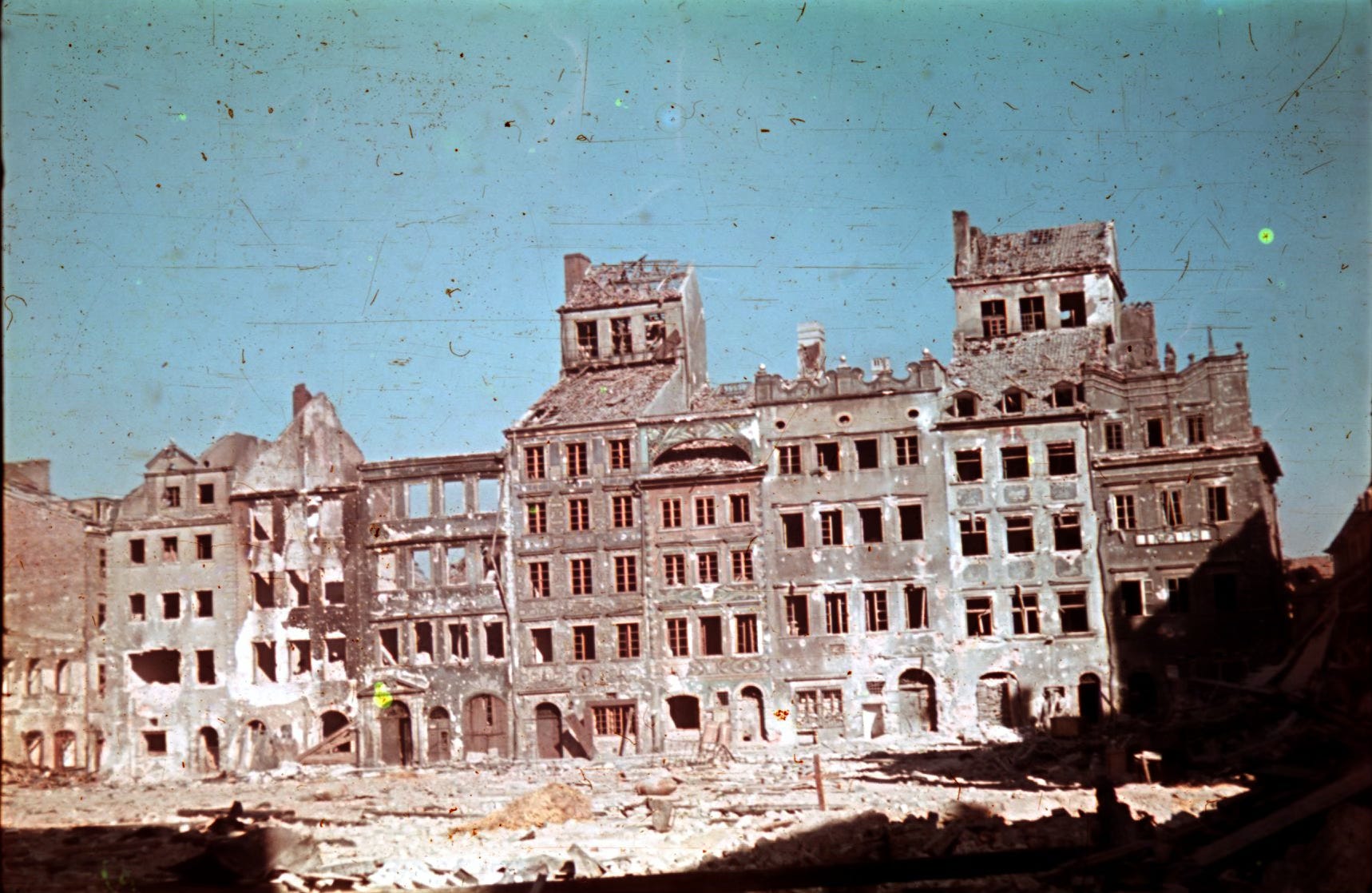
Polish resistance continued until October 2, when the Home Army gave up. Between 150,000 and 200,000 civilians had died, among them Wanda Przybylska. 16,000 resistance fighters had also been killed. The German occupiers did not only massacre large parts of the civilian population; they also burnt Warsaw to the ground, specifically targeting museums and other cultural sites. The aim was to wipe out Poland’s national heritage. Warsaw was the most destroyed city of the Second World War. One of the men responsible for the brutal suppression of the Warsaw Uprising was Heinz Reinefarth. Like so many Germans, he was never held responsible for his crimes, but was elected as mayor of Westerland (Sylt) and a member of the Schleswig-Holstein Landtag after the Second World War. His past was known in both Germany and Poland, but Polish demands to extradite him were denied. Only in 2014, seventy years after the outbreak of the Warsaw Uprising, did the Landtag in Schleswig-Holstein declare its regret that a war criminal had served in its midst.